What SmartFertilizer Is
SmartFertilizer is currently in its pilot version. The team is
validating its engineering, performance, and field readiness
through practical testing and measured results.
A farmer cannot see underground. Moisture, and eventually nutrient
conditions, vary across a single field — but decisions about
irrigation and fertilization are usually made for the whole field
at once, based on surface appearance, schedule, or experience.
SmartFertilizer is a low-cost, self-powered node that takes that
measurement where the crop actually is. It reads soil moisture,
evaluates the reading against a configurable threshold, and runs
entirely on energy it harvests itself.
We are not building a new soil sensor. We are building a
different way of deploying soil sensing: cheap enough to install
in numbers, independent enough to install without wiring, and
designed around a decision rather than a dashboard.
What We Have Built
The current prototype is a working, tested unit:
-
ESP32-based control unit — handles sensing,
threshold evaluation and power state management
-
Capacitive soil-moisture sensing — chosen over
resistive probes for corrosion resistance and longer field life
-
Solar energy harvesting — the primary power
source
-
Rechargeable energy storage — carries the node
through night and low-light periods
-
Power conversion and management — regulated
supply to the sensing and control stages
-
Threshold and decision logic — the reading is
evaluated, not just recorded
-
Modular architecture — additional sensors can
be added without redesigning the core unit
-
Field readings — taken from real soil samples,
not simulated
How the Energy Path Works
sunlight → energy management
→ storage
→ sensing
→ measurement
→ sleep
The node does not need to run continuously. Soil moisture does not
change on the timescale of seconds, so continuous operation would
spend energy for no additional information.
Instead the system operates on a duty cycle:
wake → measure
→ evaluate
→ sleep
This is the difference between attaching a solar panel to a
device and designing around an energy budget. The measurement
interval, not the panel size, is what makes long-term autonomous
operation possible.
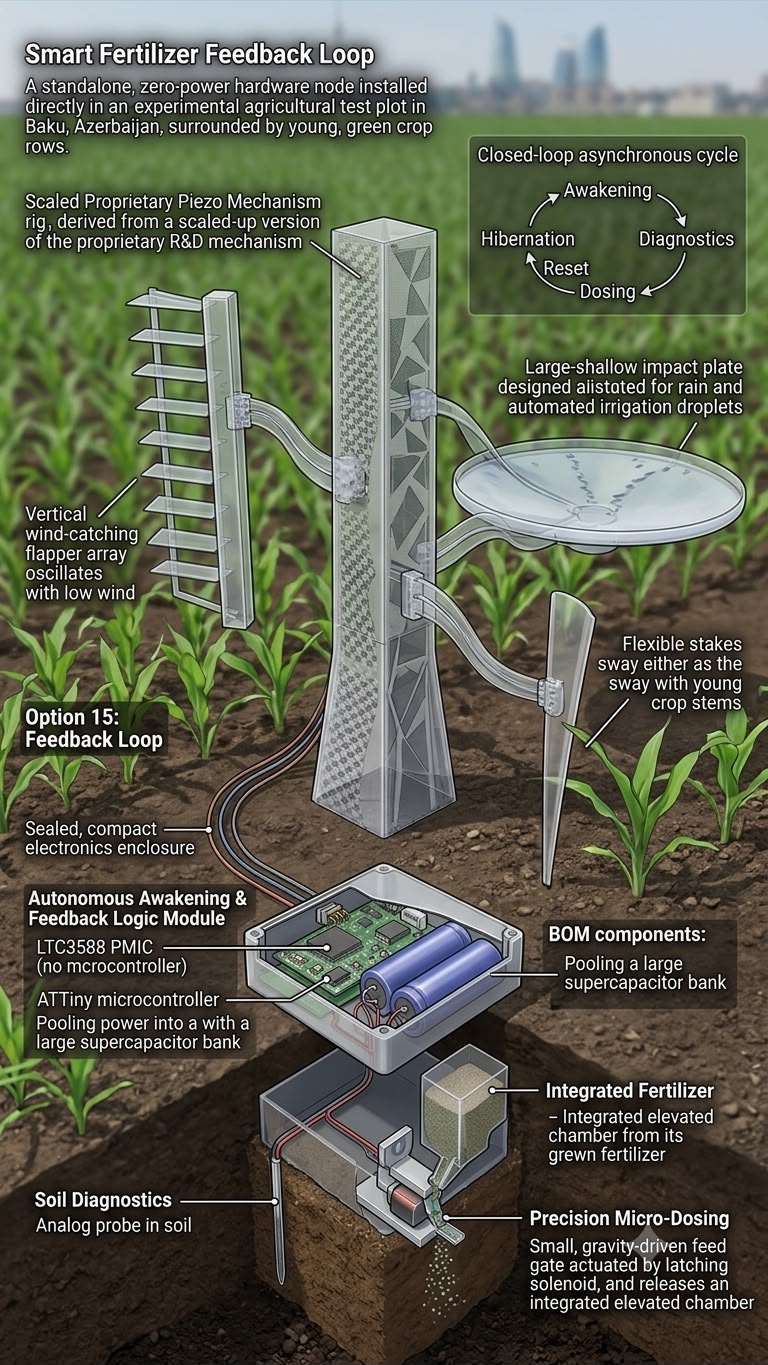
Experimental: Kinetic Energy Harvesting
Alongside the solar system we are testing a secondary,
experimental harvesting subsystem using a flexible piezoelectric
element driven by wind flutter and rain impact.
This is a research direction, not a production feature. Solar is
the primary and proven energy source for the current prototype.
We are investigating whether kinetic harvesting can meaningfully
supplement it during extended low-light periods.
Why Off-Grid Matters
A single sensor near a farmhouse can be plugged in. The value of
soil sensing, though, comes from having many measurement points —
ten, twenty, fifty across a farm — because that is the only way
to see variation.
At that point, running power to every device stops being
practical. Cabling cost, trenching, maintenance and failure
points scale with the number of nodes.
Energy autonomy is therefore not a feature of SmartFertilizer. It
is the precondition for the thing SmartFertilizer is trying to
become.
The Experiment
The question we set out to answer was not "does the sensor
produce a number."
Can SmartFertilizer distinguish meaningfully different soil
conditions?
We prepared three soil samples — dry, intermediate, and recently
irrigated — and took repeated readings from each.
The point is not that the sensor produces a number. The point is
whether that number can change a decision.
Results pending — this section will be populated with measured
readings once testing is complete. We do not populate it with
estimated values.
What We Are Building Toward
Each stage depends on the results of the one before it.
-
1
Measure — Soil moisture and environmental
conditions at a single node.
-
2
Understand — Extended sensing: soil
electrical conductivity, pH, temperature, improved moisture
accuracy — and eventually nutrient sensing, where technically
validated. Combined with crop-specific thresholds.
-
3
Map — Multiple nodes across one field,
identifying unusually dry or wet regions.
-
4
Assist — Indicating where irrigation or
fertilization attention is most needed.
-
5
Integrate — Possible connection to existing
irrigation and fertigation infrastructure.
A Note on the Name
SmartFertilizer describes where this system is going, and the
decision it is built to support.
To be precise about the current stage: the prototype does not
dispense fertilizer, and does not measure nutrient content. It
helps determine whether soil conditions are appropriate before
irrigation and fertilization decisions are made. Nutrient sensing
and any dosing capability belong to later phases, and only where
we can validate them.
Intended Impact
- Less unnecessary irrigation → lower water demand
-
Better-timed fertilization → reduced risk of unnecessary
input use
-
Locally harvested power → deployment without grid
infrastructure
-
More spatial information → intervention where it is
actually needed
What We Still Need to Validate
- Water saved per growing cycle
- Energy autonomy across seasons and weather conditions
- Sensor reliability and drift over time
- Number of nodes required per unit area
-
The relationship between our readings and real agronomic
decisions
We publish this list deliberately. The difference between a
hypothesis and a result is the whole substance of the project.
What Makes This Different
Not a new soil sensor. A different way of deploying soil
intelligence.
Low-cost · off-grid · modular · field-oriented · built and tested
locally · designed around decisions rather than dashboards.
We don't want farmers to receive more data. We want them to face
fewer uncertain decisions.